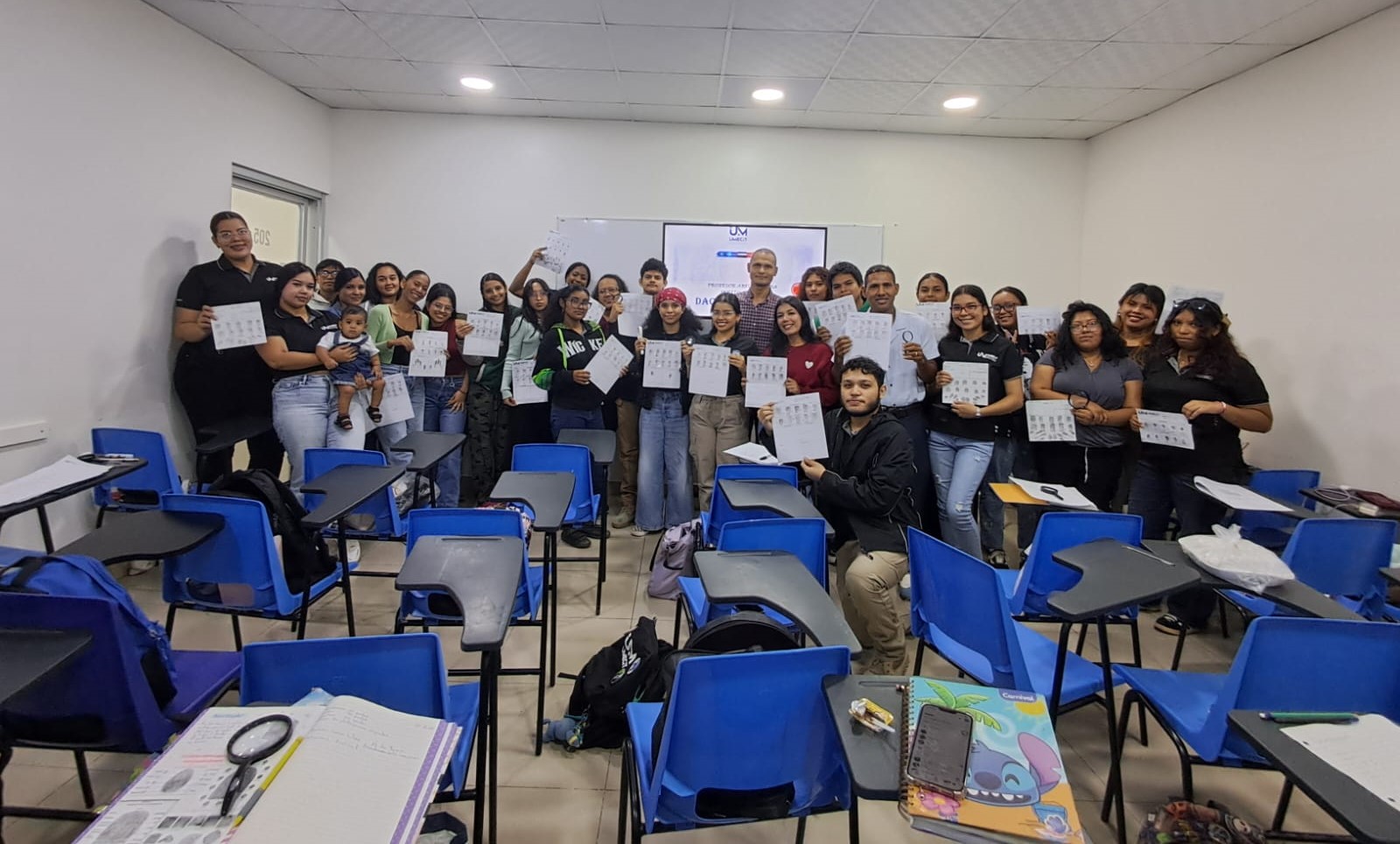
Science is also found in our fingerprints. As part of the practical learning experiences that strengthen professional training, Criminalistics students from the Saturday shift at the La Chorrera campus of UMECIT participated in an enriching Fingerprint Classification Workshop, led by Prof. Abel Guevarra.
During the activity, students had the opportunity to apply the knowledge acquired in the classroom to a practical context through the observation, analysis, and identification of different fingerprints. By studying the main papillary patterns—arches, loops, and whorls—they reinforced fundamental knowledge for human identification processes within the field of criminalistics.
The theoretical-practical experience allowed participants to develop essential skills such as observation, analysis, precision and reasoning, facing different exercises and cases that helped them to recognize the characteristics and particularities of papillary drawings.
Beyond learning how to classify a fingerprint, the workshop allowed participants to understand how scientific knowledge can become a fundamental tool in criminal and forensic investigations. Each fingerprint contains unique characteristics that, through proper analysis, can provide relevant information in an investigative process.
This type of activity reflects the importance of academic training linked to practice, where students have the opportunity to develop skills specific to their professional field and face situations that strengthen their preparation for the world of work.
At UMECIT we are committed to an education that goes beyond the classroom, promoting practical, scientific and innovative experiences that contribute to the comprehensive development of our future Criminalistics professionals.
The Fingerprint Classification Workshop reaffirms our commitment to training aimed at developing competent, analytical professionals prepared to respond to the challenges of criminal and forensic investigation.
Because behind every trace there is information, and behind every analysis, knowledge capable of contributing to clarifying the facts.