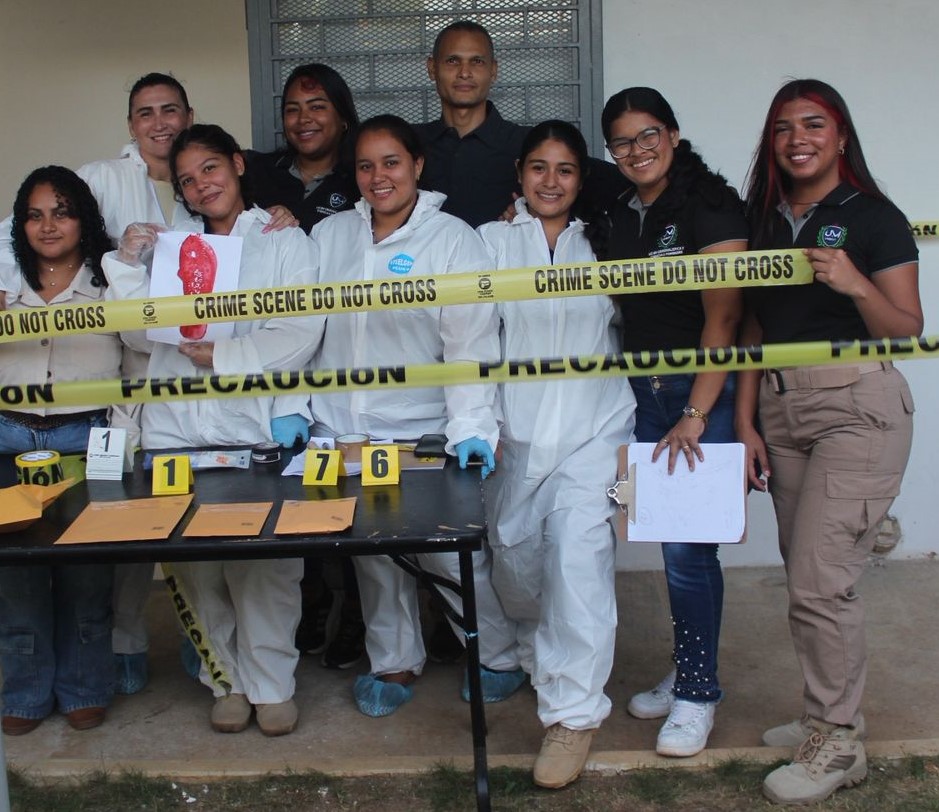
Workshop on crime scene investigation in homicide cases strengthens training in field criminalistics
UMECIT developed the Workshop on crime scene investigation in a homicide case, an academic experience aimed at strengthening the theoretical and practical skills of students in the subject Visual Inspection I, based on an applied and contextualized approach to the real demands of criminal investigation.
The workshop was designed to address the need for students to acquire fundamental skills in crime scene processing, contributing useful, technical, and legally valid information within a criminal investigation. In this sense, the activity reaffirms the relevance of Field Criminalistics as a key discipline in criminal investigations and as the central organizing principle of the university's core functions: teaching, research, and outreach.
Workshop development
The workshop included a combination of theoretical content and practical exercises, enabling participants to understand and apply essential procedures for handling homicide scenes. The workshop was coordinated in conjunction with the instructor, ensuring proper logistics, the availability of materials, personal protective equipment, and spaces for a simulated case, thus guaranteeing the active participation of all students.
Among the activities carried out, the following stand out:
Theoretical and practical explanation on the approach to the crime scene in homicide cases.
Demonstration and application of documentation procedures, scene preservation and chain of custody.
Documentary record and use of formats for taking fingerprints and palm prints.
Results and achievements
As a result of the workshop, the students strengthened key competencies, including:
Understanding crime scene preservation procedures.
Identification of biological, physical, chemical and documentary evidence.
Recognition of the phases of the investigation in homicide scenes.
Knowledge of the chain of custody and its legal importance.
Systematic observation, attention to detail, and critical analysis for the preliminary reconstruction of the facts.
Practical application of techniques for searching, securing and collecting evidence.
Teamwork and effective communication during the investigative process.
The final evaluation reflected a high level of satisfaction among the participants, who highlighted the importance of integrating theory and practice as an essential element of their professional development. The workshop's contribution to strengthening the skills necessary for the technical and ethical handling of crime scenes in homicide cases was also highly valued.